In modern electronics manufacturing, product complexity and miniaturization continue to increase. Components are becoming smaller, solder joints are becoming more critical, and process tolerances are tighter than ever. As a result, solder printing quality has become one of the most important factors affecting SMT production yield.
Industry statistics show that nearly 60–70% of SMT defects originate from the solder paste printing process. Even minor variations in solder volume, position, or shape can lead to defects such as bridging, insufficient solder, or tombstoning during reflow.
To address these challenges, many manufacturers are turning to closed-loop SPI (Solder Paste Inspection) and AOI (Automated Optical Inspection) systems. By integrating inspection data directly into the production process, closed-loop systems enable automatic process optimization and significantly improve production stability.
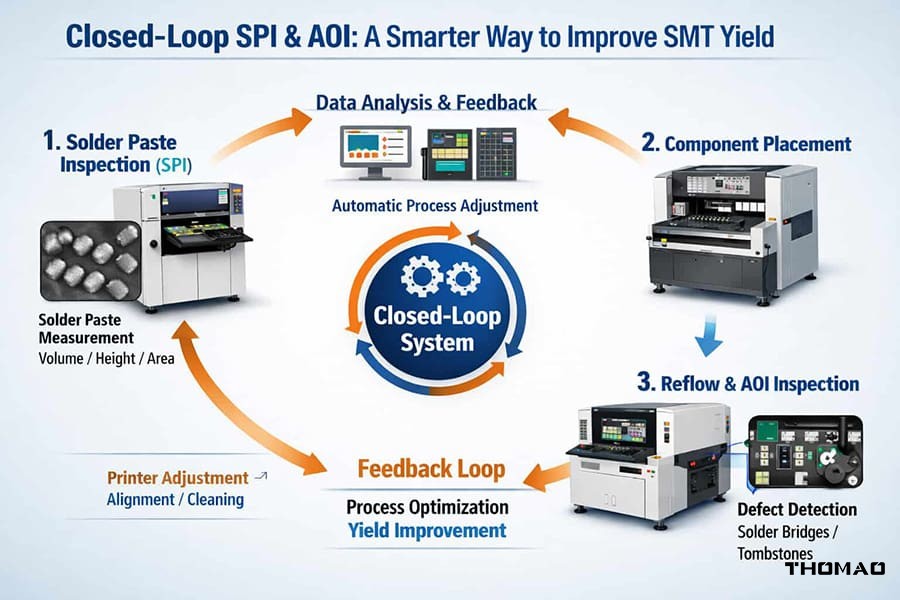
In traditional SMT production lines, SPI and AOI systems typically operate independently.
A typical workflow looks like this:
Solder paste is printed by the stencil printer.
SPI inspects the solder paste deposits.
Components are placed by pick-and-place machines.
AOI inspects the final assembly after reflow.
While this setup allows defects to be detected, it does not automatically correct the root cause of those defects. Process engineers must manually analyze inspection data and adjust machine parameters. This approach has several limitations:
Slow response to process deviations
Heavy reliance on operator experience
Increased risk of repeated defects
Reduced production efficiency
As SMT lines become faster and more automated, this traditional approach is no longer sufficient.
A closed-loop inspection system connects SPI, AOI, and production equipment through data communication and intelligent feedback.
Instead of simply detecting defects, the system can automatically adjust process parameters in real time.
The typical closed-loop process works as follows:
SPI measures solder paste parameters such as volume, height, and area.
Data is analyzed by the MES or inspection software.
If deviations are detected, feedback is sent to the stencil printer.
The printer automatically adjusts parameters such as alignment or cleaning cycles.
In more advanced systems, AOI inspection data after reflow can also be fed back to earlier processes to optimize printing or placement conditions.
This creates a self-correcting production loop, where inspection data continuously improves process performance.
Closed-loop systems reduce process variation by automatically correcting printing deviations. This leads to more consistent solder paste deposits and stable production conditions.
By addressing problems at the earliest stage of the SMT process, closed-loop systems significantly reduce downstream defects. Many manufacturers report substantial improvements in first-pass yield after implementing closed-loop SPI feedback.
Traditional process adjustments rely heavily on engineers. Closed-loop systems automate many of these corrections, reducing the need for manual intervention and minimizing human error.
Real-time data analysis allows process deviations to be detected immediately, preventing large batches of defective products.
Closed-loop inspection is a key component of Industry 4.0 and smart factory strategies, enabling data-driven manufacturing and intelligent production control.
The effectiveness of a closed-loop system depends heavily on data integration across multiple machines.
Key technologies include:
Machine-to-machine communication protocols
Centralized data platforms or MES systems
Advanced analytics and defect classification
Real-time feedback algorithms
By combining inspection data with process parameters, manufacturers can gain deeper insights into production performance and continuously optimize their SMT processes.
While closed-loop systems offer significant advantages, successful implementation requires careful planning.
Manufacturers should consider:
Compatibility between SPI, AOI, and production equipment
Data communication standards (e.g., IPC-CFX or Hermes)
Process parameter control capabilities of stencil printers
Integration with MES or factory automation systems
Proper system design ensures that feedback mechanisms are both reliable and effective.
As electronics manufacturing continues to evolve, maintaining high SMT yield requires more advanced process control strategies. Traditional inspection systems that only detect defects are no longer sufficient in high-speed, high-precision production environments.
Closed-loop SPI and AOI systems represent a major step forward in SMT process optimization. By transforming inspection data into actionable feedback, these systems enable manufacturers to achieve higher yield, greater stability, and improved production efficiency.
For companies pursuing smart manufacturing and Industry 4.0, closed-loop inspection is becoming an essential component of the modern SMT production line.
Previous article:New placement platform from ASMPT SMT Solutions
Next article:no more