
Email Us

SMT Troubleshooting

How to Choose the Right SMT Conveyor for Your Production Line

Content

Choosing the right SMT conveyor is critical for stable PCB transfer and overall line efficiency.
However, many buyers focus only on conveyor length or price, while ignoring system compatibility and production flow.

This guide explains how to make the right decision.


Download
  • Product Details
  • Parameter
  • Video

Content

Choosing the right SMT conveyor is critical for stable PCB transfer and overall line efficiency.
However, many buyers focus only on conveyor length or price, while ignoring system compatibility and production flow.

This guide explains how to make the right decision.
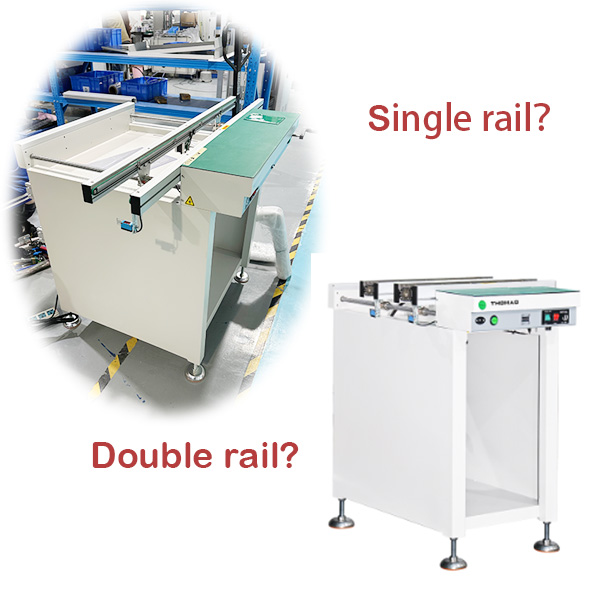
------------------------------------------------------------------------------------------------------------------------------------------------------------------------------

1. What Problem Are You Trying to Solve?

Before selecting a conveyor, clarify your real objective:

  • Connecting machines from different brands

  • Reducing manual PCB handling

  • Solving unstable board transfer

  • Adding buffer capacity to avoid line blocking

A conveyor is not just a mechanical device — it is part of the PCB flow system.

-----------------------------------------------------------------------------------------------------------------------------------------------------------------------------

2. Key Parameters to Consider

Important factors include:

  • PCB size range and thickness

  • Conveyor width adjustment method

  • Transfer speed and stability

  • SMEMA signal compatibility

  • Sensor and board stop configuration

  • Space constraints on the production floor

Ignoring any of these may cause future integration issues.

-----------------------------------------------------------------------------------------------------------------------------------------------------------------------------

3. Common Buyer Mistakes

Typical mistakes include:

  • Selecting the shortest or cheapest conveyor

  • Assuming all SMEMA conveyors behave the same

  • Ignoring future line expansion

  • Overlooking inspection or buffer requirements

These mistakes often lead to hidden costs and repeated adjustments.

---------------------------------------------------------------------------------------------------------------------------------------------------------------------------

4. Different Production Scenarios Explained

  • High-mix, low-volume: Flexible width adjustment and buffer capacity

  • High-volume: Stable transfer timing and minimal vibration

  • Multi-brand line: SMEMA signal coordination is critical

  • Semi-automatic line: Manual and automated flow must be balanced

Each scenario requires a different conveyor strategy.

-------------------------------------------------------------------------------------------------------------------------------------------------------------------------

5. When a System Solution Is Needed

If conveyor selection affects multiple machines or future upgrades, it is best treated as part of a line-level design.

👉 Our SMT Line Layout Design Solution helps you select and integrate conveyors based on your full production flow.

--------------------------------------------------------------------------------------------------------------------------------------------------------------------------

This issue is part of a broader PCB transfer and line stability topic.
Please refer to our
 SMT Troubleshooting Hub.


CONTACT US
Welcome your presence, you can send us an email, we will get in touch with you within 24 hours.
Room 502, Building 3H, Quanzhi Technology Industrial Park, Bao'an District, Shenzhen, China
sales@thomao.com
0086-176 0765 6429