
Email Us

Process Optimization

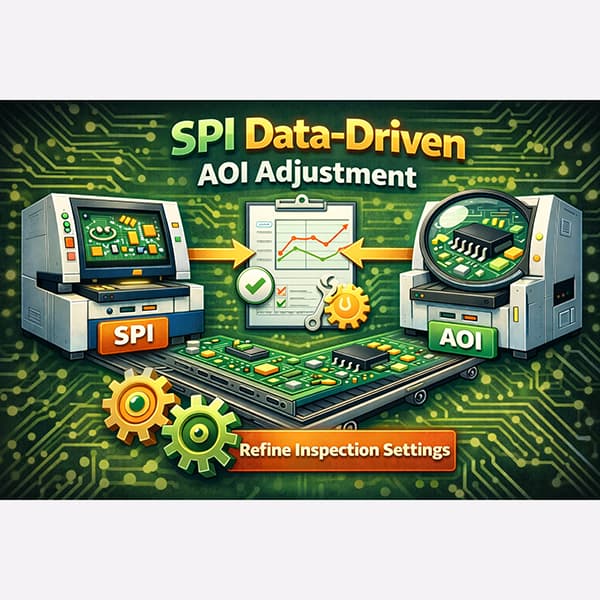
SPI Data-Driven AOI Adjustment – A Practical Implementation Guide for SMT Engineers

Many SMT lines attempt to reduce AOI false calls by continuously adjusting AOI parameters.
In practice, this approach often fails because AOI is reacting to symptoms, not root causes.

SPI provides rich, upstream process data that reflects solder paste stability and variation.
When used correctly, SPI data can guide intelligent AOI adjustment, significantly reducing false calls while maintaining inspection integrity.

This guide explains how to implement SPI data-driven AOI adjustment step by step, based on real production logic.

Download
  • Product Details
  • Parameter
  • Video

1. Why AOI Alone Is Not Enough

AOI detects assembly results, but it does not understand:

  • Printing process stability

  • Normal solder volume variation

  • Acceptable paste behavior

Without upstream context, AOI often flags normal variation as defects.

SPI fills this gap by providing quantitative, process-level insight.


2. What SPI Data Is Useful for AOI Adjustment

Not all SPI data is equally valuable. Focus on:

  • Solder volume distribution

  • Height and area trend

  • Cp / Cpk values

  • Pad-level consistency

  • Trend drift over time

These metrics indicate whether a solder joint appearance is normal or risky.


3. Establish a Stable SPI Baseline

Before linking SPI to AOI:

  1. Run SPI under normal production conditions

  2. Collect data across multiple boards and shifts

  3. Confirm process stability (Cp/Cpk ≥ target)

  4. Eliminate known printing issues

AOI adjustment based on unstable SPI data will amplify problems.


4. Classify AOI False Calls Using SPI Context

For each AOI false call, ask:

  • Did SPI show abnormal paste behavior?

  • Is this variation within SPI control limits?

  • Is the defect cosmetic or functional?

This classification separates real risks from acceptable variation.


5. Map SPI Metrics to AOI Parameters

Create logical relationships such as:

SPI IndicatorAOI Adjustment Strategy
Stable volume & heightRelax AOI solder threshold
Consistent pad trendReduce cosmetic sensitivity
Drift detectedMaintain or tighten AOI limits
High variationInvestigate printing, not AOI

AOI rules should respond to SPI reality, not static assumptions.


6. Implement Tiered AOI Thresholds

Instead of one fixed limit:

  • Tier 1: Normal SPI → Relaxed AOI

  • Tier 2: Borderline SPI → Standard AOI

  • Tier 3: SPI drift → Tight AOI + alert

This dynamic approach dramatically reduces false calls.


7. Adjust AOI by Component and Pad Type

SPI data varies by:

  • Component size

  • Pad geometry

  • Solder paste aperture

Use SPI segmentation to:

  • Tune AOI rules per component family

  • Avoid over-penalizing small passives

  • Focus inspection on high-risk joints


8. Integrate SPI Trends into AOI Review Logic

When SPI trend alarms appear:

  • Prioritize AOI review

  • Trigger engineering review

  • Increase inspection sensitivity temporarily

When SPI is stable:

  • Minimize manual AOI review

  • Maintain smooth line flow


9. Manage Change Control Carefully

SPI-driven AOI changes should:

  • Be documented

  • Require engineering approval

  • Be reversible

Uncontrolled parameter drift creates long-term risk.


10. KPIs to Track After Implementation

Measure success using:

  • AOI false call rate

  • AOI review time per board

  • Line blocking incidents

  • First-pass yield (FPY)

  • Inspection takt time

Data should confirm improvement—not just perception.


11. Common Implementation Mistakes

Avoid:

  • Blindly loosening AOI rules

  • Ignoring SPI data quality

  • Over-reacting to short-term spikes

  • Adjusting AOI without process ownership

SPI-driven adjustment is engineering discipline, not trial and error.


Conclusion

SPI data-driven AOI adjustment transforms inspection from a reactive filter into a process-aware quality system.

When SPI and AOI work together:

  • False calls decrease

  • Inspection flow stabilizes

  • Quality risk becomes visible early

This approach represents mature SMT process control.


Linking Suggested Reading


Thomao Engineering Insight

AOI sees the result.
SPI understands the process.
Data connects both.


CONTACT US
Welcome your presence, you can send us an email, we will get in touch with you within 24 hours.
Room 502, Building 3H, Quanzhi Technology Industrial Park, Bao'an District, Shenzhen, China
sales@thomao.com
0086-176 0765 6429