
Email Us

SMT Troubleshooting

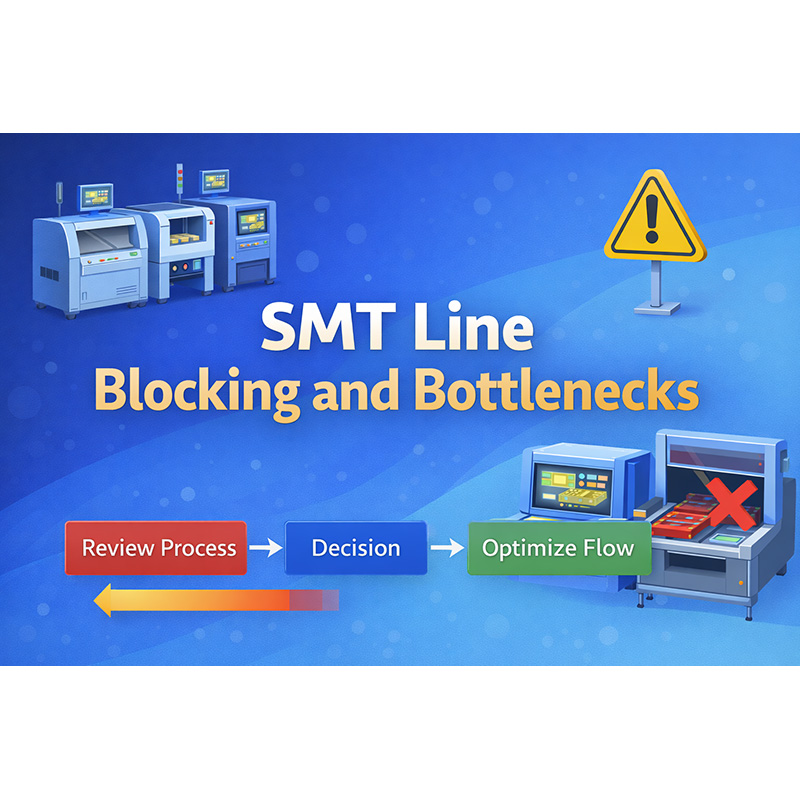
SMT Line Blocking and Bottlenecks – Causes, Impact, and Practical Solutions

Introduction

SMT line blocking and bottlenecks are among the most common challenges in modern electronics manufacturing.
Even with high-speed placement machines, a single bottleneck can slow the entire line, reduce throughput, and increase operational cost.

This article explains why SMT line blocking occurs, how to identify bottlenecks, and practical solutions to restore smooth PCB flow.

Download
  • Product Details
  • Parameter
  • Video

Introduction

SMT line blocking and bottlenecks are among the most common challenges in modern electronics manufacturing.
Even with high-speed placement machines, a single bottleneck can slow the entire line, reduce throughput, and increase operational cost.

This article explains why SMT line blocking occurs, how to identify bottlenecks, and practical solutions to restore smooth PCB flow.


What Is SMT Line Blocking?

SMT line blocking occurs when:

  • An upstream machine cannot transfer PCB forward

  • A downstream machine is not ready to receive PCB

  • The conveyor system stops due to process imbalance

Blocking is usually a system-level issue, not a single machine failure.


Common Symptoms of SMT Bottlenecks

Typical warning signs include:

  • Frequent machine waiting status

  • Accumulated PCBs at specific stations

  • Uneven machine utilization

  • Repeated line stop alarms

  • Output far below theoretical capacity

Identifying these symptoms early helps minimize production loss.


Main Causes of SMT Line Blocking and Bottlenecks

1. Uneven Cycle Time Between Machines

Different process speeds can create natural bottlenecks, especially at:

  • Screen printing

  • Reflow ovens

  • AOI or SPI inspection stations

A slow process station will block faster upstream equipment.


2. PCB Transfer and Conveyor Issues

Mechanical or communication problems such as:

  • SMEMA signal instability

  • Conveyor height mismatch

  • Sensor misalignment

can interrupt PCB flow and cause blocking.


3. Inspection-Induced Bottlenecks

SPI and AOI machines often become bottlenecks due to:

  • High inspection resolution settings

  • Excessive false calls

  • Frequent manual review

Inspection optimization is critical for maintaining line balance.


4. Manual Intervention and Handling Delays

Manual processes introduce variability, including:

  • Board rework stations

  • Visual inspection points

  • Manual unloading or buffering

Human-dependent steps are common bottleneck sources.


5. Product Changeover Inefficiency

Frequent product changes may lead to:

  • Extended setup time

  • Parameter mismatches

  • Incomplete validation

Changeover inefficiency compounds blocking issues.


How to Identify Bottlenecks Effectively

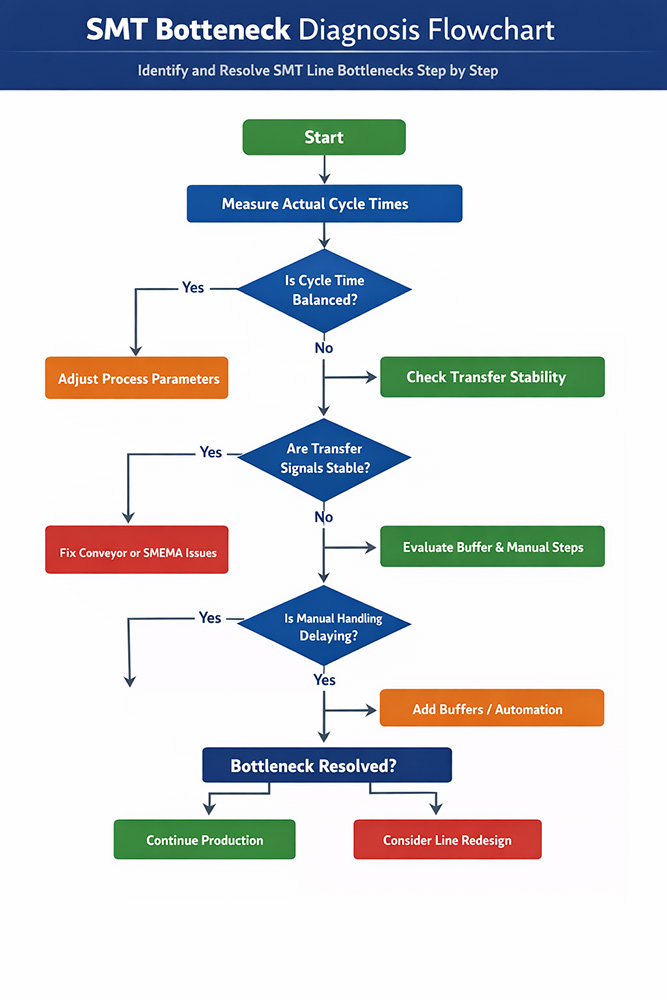
Step 1: Measure Actual Cycle Times
Compare real production data across all stations.

Step 2: Observe PCB Accumulation Points
Bottlenecks often appear where PCBs queue up.

Step 3: Review Machine Utilization Data
Underused machines upstream signal downstream constraints.

Step 4: Check Transfer Logs and Alarms
Frequent transfer errors point to flow problems.


Practical Solutions to Reduce SMT Line Blocking

Balance Machine Throughput

  • Adjust cycle times and inspection parameters

  • Add parallel inspection if necessary

Improve PCB Transfer Stability

  • Standardize conveyor height and width

  • Optimize SMEMA communication

Add Buffering and Automation

  • Smart buffers absorb cycle time variation

  • Automation reduces manual delays

Optimize Inspection Strategy

  • Reduce false calls

  • Use risk-based inspection settings

Improve Changeover Management

  • Standardize setup procedures

  • Use digital work instructions


When to Redesign Your SMT Line

If bottlenecks persist despite optimization, consider:

  • SMT line layout redesign

  • Adding automated conveyors or buffers

  • Upgrading inspection equipment

👉 Learn more in our SMT Line Layout Design and SMEMA / Automation Solutions sections.


Conclusion

SMT line blocking and bottlenecks are rarely caused by a single machine.
They result from imbalanced processes, unstable transfer, and insufficient automation.

A systematic, data-driven approach can significantly improve throughput and line stability.


Internal Linking Suggestions


Thomao Engineering Insight

A fast SMT machine does not guarantee a fast SMT line.
Line balance and flow stability matter more than peak speed.


CONTACT US
Welcome your presence, you can send us an email, we will get in touch with you within 24 hours.
Room 502, Building 3H, Quanzhi Technology Industrial Park, Bao'an District, Shenzhen, China
sales@thomao.com
0086-176 0765 6429