
Email Us

SMT Troubleshooting

SMEMA Signal Communication Issues – Causes, Troubleshooting, and Best Practices

Introduction

SMEMA (Surface Mount Equipment Manufacturers Association) signaling is a widely adopted standard for communication between SMT machines.
When SMEMA signal communication issues occur, PCB transfer between machines may fail, resulting in line blocking, downtime, and reduced productivity.

This article explains the most common SMEMA signal problems, how to troubleshoot them, and best practices to ensure stable SMT line operation.


Download
  • Product Details
  • Parameter
  • Video

Introduction

SMEMA (Surface Mount Equipment Manufacturers Association) signaling is a widely adopted standard for communication between SMT machines.
When SMEMA signal communication issues occur, PCB transfer between machines may fail, resulting in line blocking, downtime, and reduced productivity.

This article explains the most common SMEMA signal problems, how to troubleshoot them, and best practices to ensure stable SMT line operation.


What Is SMEMA Communication?

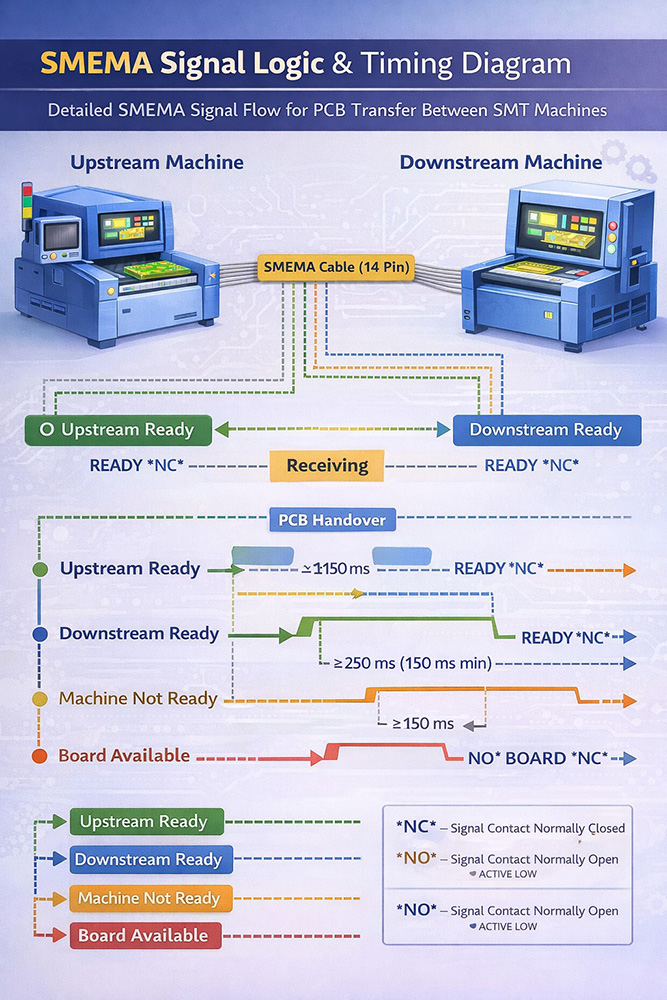
SMEMA uses simple digital signals to indicate:

  • PCB ready to send (Upstream Ready)

  • PCB ready to receive (Downstream Ready)

These signals allow machines from different manufacturers to coordinate PCB transfer 

without complex software integration.


Common Symptoms of SMEMA Signal Issues

SMEMA communication problems often show as:

  • PCB not transferring to the next machine

  • Upstream machine waiting indefinitely

  • Downstream machine not accepting PCB

  • Random or intermittent transfer failures

  • SMT line blocking alarms

These symptoms usually point to communication rather than mechanical failure.


Main Causes of SMEMA Communication Issues

1. Incorrect Wiring or Pin Assignment

Common wiring issues include:

  • Reversed signal lines

  • Incorrect pin configuration

  • Missing ground reference

  • Poor cable quality

Even a single miswired pin can disrupt SMEMA communication.


2. Signal Polarity Mismatch

Different SMT machine brands may interpret SMEMA signals as:

  • Active high

  • Active low

A polarity mismatch prevents proper handshake between machines.


3. Loose or Damaged Connectors

Frequent plugging/unplugging may cause:

  • Bent pins

  • Oxidized contacts

  • Intermittent signal loss

This often results in unpredictable PCB transfer behavior.


4. Software Configuration Errors

Incorrect parameter settings such as:

  • Wrong transfer mode

  • Disabled SMEMA function

  • Safety interlock conflicts

can block signal transmission even if wiring is correct.


5. Brand Compatibility Differences

Some SMT machines implement SMEMA slightly differently, leading to:

  • Timing mismatches

  • Additional safety logic

  • Delayed signal response

Mixed-brand SMT lines are more prone to these issues.


Step-by-Step SMEMA Troubleshooting Guide

Step 1: Verify Cable Wiring
Check pin assignments against SMEMA standards.

Step 2: Confirm Signal Polarity
Match upstream and downstream polarity settings.

Step 3: Inspect Connectors and Pins
Replace damaged cables or connectors.

Step 4: Review Software Settings
Ensure SMEMA mode is enabled on both machines.

Step 5: Test with Bypass or Simulation
Use test signals to confirm handshake logic.


Best Practices for Stable SMEMA Communication

  • Use standardized SMEMA cables across the line

  • Label upstream and downstream connections clearly

  • Document SMEMA parameters for each machine

  • Avoid frequent cable reconnections

  • Perform routine signal integrity checks

Preventive measures help reduce unplanned downtime.


When to Upgrade Beyond Basic SMEMA

If your SMT line experiences frequent SMEMA issues, consider:

  • Smart conveyors with advanced handshake logic

  • PLC-based automation interfaces

  • Ethernet-based communication upgrades

👉 Explore our SMEMA / Automation Solutions for more reliable PCB transfer control.


Conclusion

SMEMA signal communication issues are a common but solvable challenge in SMT production.
With proper wiring, configuration, and preventive maintenance, SMEMA can deliver reliable and cost-effective machine communication.


Internal Linking Suggestions


Thomao Engineering Insight

SMEMA works best when treated as a system,
not just a cable between two machines.


CONTACT US
Welcome your presence, you can send us an email, we will get in touch with you within 24 hours.
Room 502, Building 3H, Quanzhi Technology Industrial Park, Bao'an District, Shenzhen, China
sales@thomao.com
0086-176 0765 6429