
Email Us

Process Optimization

Reflow Soldering Technical Support Guide for SMT Production Lines

Introduction to Reflow Soldering

Reflow soldering is the most widely used soldering method in Surface Mount Technology (SMT). It allows solder paste to melt and form reliable electrical and mechanical connections between electronic components and PCB pads through a controlled thermal process.

Download
  • Product Details
  • Parameter
  • Video

Why Reflow Profile Optimization Matters

In SMT production, reflow soldering is one of the most critical process steps affecting product reliability and yield.
An improperly optimized reflow profile often leads to soldering defects, rework, or field failures.

This technical support guide provides practical recommendations used in real SMT production environments to help customers stabilize their reflow process.


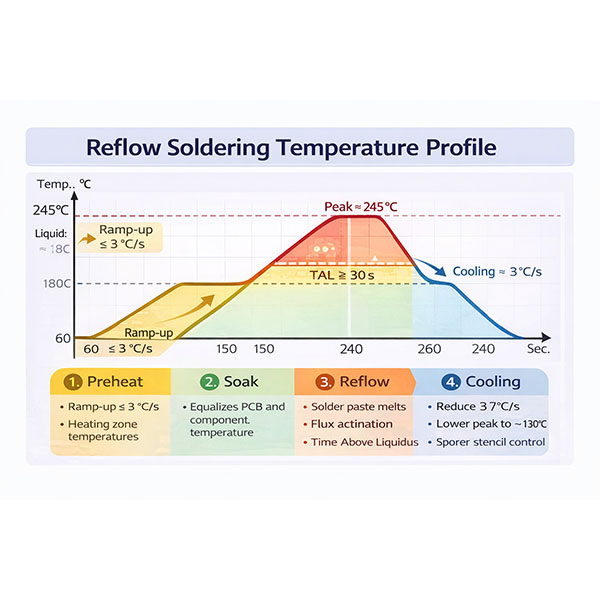
Standard Reflow Profile Overview

A stable reflow process is typically divided into four controlled phases:

Preheat Zone

  • Gradual temperature increase activates flux and evaporates solvents

  • Prevents solder paste slumping and excessive out-gassing
    Recommended ramp rate: 0.75–1.0°C/sec


Soak Zone

  • Equalizes PCB and component temperatures

  • Prevents tombstoning and cold joints

Typical parameters:

  • Time: 90–150 seconds

  • Temperature: 150–170°C

⚠️ Excessive soak time may exhaust flux and increase oxidation.


Reflow (Peak) Zone

  • Solder paste melts and forms reliable solder joints

Recommended peak temperatures:

  • Sn63Pb37: 215–225°C

  • Lead-free (reference): 235–245°C

Time Above Liquidus (TAL):
30–90 seconds (preferably <60 seconds)


Cooling Zone

  • Cooling speed directly affects joint strength

Recommended cooling rate:
3–4°C/sec down to ~130°C

Fast cooling results in finer grain structure and stronger solder joints.


Conveyor Speed and Profile Adjustment

The final soldering profile is controlled by:

  • Heating zone temperatures

  • Cooling zone settings

  • Conveyor speed

For densely populated or high-mass PCBs, reducing conveyor speed allows better heat transfer and profile stability.
This method is most effective in forced convection reflow ovens.


Materials That Influence Reflow Quality

Solder Paste

Key parameters to consider:

  • Solvent evaporation temperature

  • Flux activation temperature

  • Activation duration

Incorrect matching between solder paste and profile is a major cause of soldering defects.


PCB and Component Solderability

Good solderability of pads and terminals ensures proper wetting and joint formation.
Oxidation or contamination increases defect risk.


Soldering Atmosphere (Air vs Nitrogen)

  • Nitrogen reduces oxidation and improves wetting

  • However, higher surface tension may increase tombstoning or bridging if not properly controlled

Nitrogen should be applied as a process optimization tool, not a universal fix.


Environmental and Operator Considerations

Production Environment

  • Dust, fibers, or contamination can cause bridging and poor wetting

  • Incorrect exhaust airflow can destabilize the reflow process


Operator Role

Modern reflow soldering is highly automated.
Operators mainly need to:

  • Select the correct validated profile

  • Monitor alarms and process stability

  • Avoid unverified manual adjustments


Common Reflow Defects and Practical Solutions

DefectMain CauseRecommended Action
Solder BallingRapid solvent evaporationReduce preheat ramp rate
Solder BeadingExcess solder pasteOptimize stencil thickness
WickingTerminal hotter than padExtend soak time
Poor WettingOxidation, over-heatingReduce thermal exposure
TombstoningUnequal wetting forcesReduce ΔT, improve soak
BridgingPrinting errors, contaminationImprove stencil control
Cold JointsLow peak temperatureIncrease peak to spec
VoidingTrapped gasesSlow preheat, adjust TAL
Excessive IMCHigh temp / long TALLower peak & TAL
CracksThermal / mechanical stressReduce heating/cooling shock

How Our Technical Support Helps

Our SMT technical support team assists customers with:

  • ✔ Reflow profile setup and optimization

  • ✔ Defect root cause analysis

  • ✔ Oven parameter recommendations

  • ✔ Process validation for new products

  • ✔ On-site or remote process support

We focus on practical, production-ready solutions, not theoretical settings.


Contact Our SMT Technical Support Team

If you are experiencing reflow soldering issues or planning to optimize a new SMT production line, our engineers are ready to support you.

📩 Contact us for reflow process consultation and on-site support

      1. SMT Line Layout Design 

      2. SMEMA/Automation Solutions

      3. Factory Upgrade Projects


CONTACT US
Welcome your presence, you can send us an email, we will get in touch with you within 24 hours.
Room 502, Building 3H, Quanzhi Technology Industrial Park, Bao'an District, Shenzhen, China
sales@thomao.com
0086-176 0765 6429