
Email Us

Process Optimization

Closed-Loop SPI/AOI Process Control in SMT Manufacturing

Introduction

In modern SMT manufacturing, inspection alone is no longer enough. While SPI (Solder Paste Inspection) and AOI (Automated Optical Inspection) systems are widely deployed, many factories still operate them as independent checkpoints rather than integrated control tools.

A closed-loop SPI/AOI system transforms inspection data into automatic process correction — shifting from defect detection to defect prevention.

This article explains how closed-loop control works, why it matters, and how it significantly improves Cpk and first-pass yield.

Download
  • Product Details
  • Parameter
  • Video
  1. Why SPI Alone Does Not Guarantee Quality

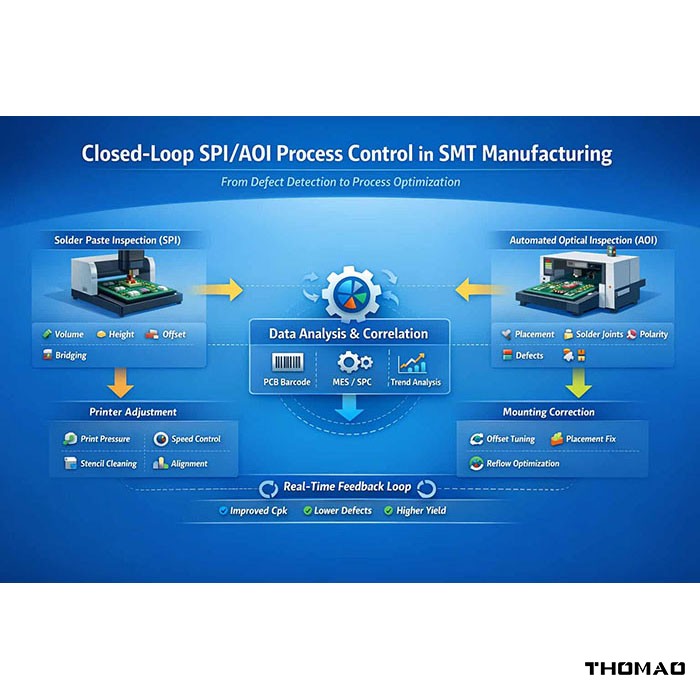
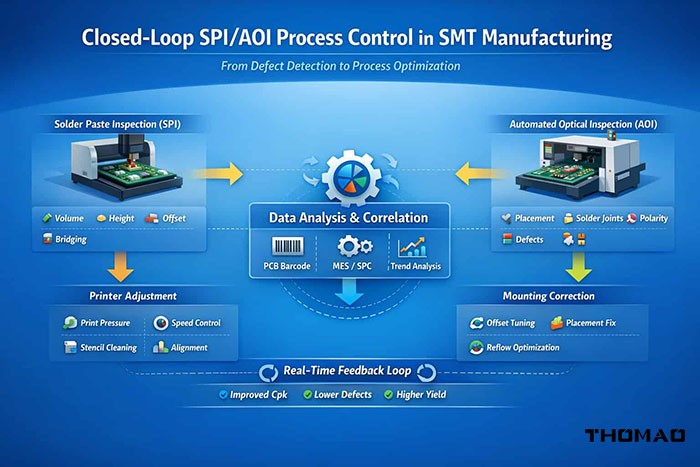
closed-loop SPI-AOI process control in SMT manufacturing.jpg

SPI systems measure solder paste:

  • Volume

  • Height

  • Area

  • Offset

  • Bridging

Leading 3D SPI manufacturers such as Koh Young and CyberOptics have made volume measurement extremely accurate.

However, SPI only verifies printing quality, not final solder joint reliability.

Example:

  • SPI shows OK paste volume

  • Component placement slightly offset

  • Reflow causes tombstoning

  • AOI detects failure

Conclusion:
SPI = Process indicator
AOI = Result indicator

SPI alone cannot guarantee final product quality.


2. Why AOI Cannot Independently Determine Root Cause

AOI systems (such as those from Omron or Viscom) detect:

  • Missing components

  • Tombstones

  • Polarity errors

  • Solder bridges

  • Insufficient solder

But AOI identifies symptoms, not root causes.

For example:

AOI detects insufficient solder.

Possible causes:

  1. Low solder paste volume (printing issue)

  2. Excess placement pressure

  3. Poor reflow profile

  4. Pad contamination

Without SPI data correlation, AOI alone cannot assign responsibility.

This is where closed-loop logic becomes essential.


3. SPI + AOI Responsibility Matrix Model

A responsibility matrix correlates SPI and AOI results:

SPI ResultAOI ResultRoot Cause Direction
NGNGPrinting problem
NGOKPlacement compensation occurred
OKNGPlacement or reflow issue
OKOKStable process

This matrix eliminates subjective judgment and creates data-based root cause classification.

When implemented within MES or inspection software, the system automatically:

  • Identifies trend patterns

  • Detects repeated defect concentration areas

  • Triggers process adjustment recommendations

This is the foundation of closed-loop optimization.


4. Closed-Loop Control Architecture

A typical closed-loop SPI/AOI architecture includes:

Step 1 – Data Acquisition

  • 3D SPI captures paste metrics

  • AOI captures post-reflow defect data

  • PCB barcode links both datasets

Step 2 – Data Correlation

  • Board-level mapping

  • Component-level comparison

  • Regional trend analysis

Step 3 – Process Feedback

Based on analysis, the system automatically adjusts:

To Printer:

  • Squeegee pressure

  • Print speed

  • Separation speed

  • Cleaning frequency

To Pick & Place Machine:

  • X/Y offset correction

  • Placement force optimization

Global equipment suppliers such as ASMPT and Hanwha Precision Machinery already support advanced data interfaces for this type of integration.


5. Real Case Study Example

Production Line: Automotive Control Board
Monthly Output: 120,000 boards

Before Closed-Loop Implementation:

  • Average Solder Paste Cpk: 1.12

  • AOI False Call Rate: 18%

  • First Pass Yield (FTY): 91.5%

Major issue:
Localized low-volume printing at PCB corners causing tombstoning.

After Closed-Loop SPI→Printer Feedback:

  • Automatic regional compensation enabled

  • Cleaning frequency dynamically adjusted

  • Placement offset fine-tuned based on SPI deviation

Results (3 months later):

  • Solder Paste Cpk: 1.58

  • AOI False Call Rate: 11%

  • FTY: 96.3%

Defect escape rate reduced by 42%.


6. Cpk Improvement Comparison

ParameterBeforeAfter
Paste Volume Cpk1.121.58
Height Variation±22%±11%
Tombstone Rate0.85%0.31%
Rework Rate6.8%2.9%

The key improvement driver was not new hardware — it was data-driven feedback control.


Please wait for updates to the following related topics

✔ Converts inspection into process control
✔ Reduces engineering dependency
✔ Enables predictive maintenance
✔ Improves process stability
✔ Supports Industry 4.0 initiatives
✔ Enhances traceability and accountability


CONTACT US
Welcome your presence, you can send us an email, we will get in touch with you within 24 hours.
Room 502, Building 3H, Quanzhi Technology Industrial Park, Bao'an District, Shenzhen, China
sales@thomao.com
0086-176 0765 6429