Email Us

Equipment Comparison

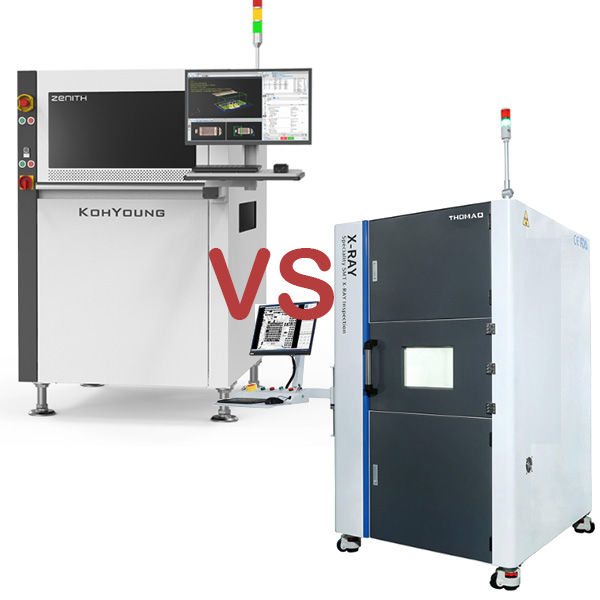
X-Ray vs AOI – Inspection Boundary Explained

Introduction

AOI and X-Ray are two of the most commonly used inspection technologies in SMT manufacturing.
However, many quality issues occur not because inspection is missing — but because the wrong inspection technology is applied to the wrong problem.


Download
  • Product Details
  • Parameter
  • Video

Introduction

AOI and X-Ray are two of the most commonly used inspection technologies in SMT manufacturing.
However, many quality issues occur not because inspection is missing — but because the wrong inspection technology is applied to the wrong problem.

This article explains the inspection boundary between AOI and X-Ray, helping engineers and decision-makers understand:


  • What AOI can reliably detect

  • What AOI cannot see

  • Where X-Ray inspection becomes necessary

  • How to define a proper inspection strategy

-------------------------------------------------------------------------------------------------------------------------------------

What AOI Is Designed to Do

Automated Optical Inspection (AOI) relies on cameras and lighting to inspect visible surfaces of electronic assemblies.

AOI is highly effective at detecting:

  • Component presence and polarity

  • Placement offset and rotation

  • Solder bridges on visible pads

  • Missing or incorrect components

  • Obvious surface defects

AOI is fast, repeatable, and well suited for inline inspection in SMT lines.

-------------------------------------------------------------------------------------------------------------------------------------

The Natural Boundary of AOI Inspection

Despite its strengths, AOI has clear physical limitations.

AOI cannot reliably inspect:

  • Hidden solder joints (BGA, CSP, QFN)

  • Internal voids or cracks

  • Solder quality beneath components

  • Inner-layer defects or internal connections

No amount of software tuning can overcome the fact that AOI cannot see through materials.

This is where many inspection misunderstandings begin.

--------------------------------------------------------------------------------------------------------------------------------------

What X-Ray Inspection Is Designed to Do

X-Ray inspection is a non-destructive technology that allows engineers to see inside electronic assemblies.

X-Ray inspection excels at detecting:

  • BGA / CSP solder joint voids

  • Insufficient or excessive solder under components

  • Hidden bridges and shorts

  • Internal cracks and cold solder joints

  • IC package and semiconductor defects

X-Ray does not replace AOI — it complements it.

------------------------------------------------------------------------------------------------------------------------------------------

X-Ray Inspection Limitations

X-Ray inspection also has boundaries.

It is generally:

  • Slower than inline AOI

  • Less suitable for 100% inline inspection

  • Used mainly for analysis, verification, or sampling

  • More dependent on skilled interpretation

X-Ray is best positioned as a quality analysis and confirmation tool, not a high-speed screening tool.

---------------------------------------------------------------------------------------------------------------------------------------------

AOI vs X-Ray – Inspection Boundary Comparison

Inspection AspectAOIX-Ray
Surface inspection✅ Excellent⚠️ Limited
Hidden solder joints❌ Not visible✅ Excellent
Inline inspection✅ Ideal❌ Rare
Internal defect analysis❌ Not possible✅ Core strength
Production speed✅ High❌ Lower
Root cause analysis⚠️ Limited✅ Strong

This boundary defines where each technology should be applied.

-------------------------------------------------------------------------------------------------------------------------------------

Why Inspection Strategy Matters More Than Equipment

Many factories invest heavily in inspection equipment but still face quality issues because:

  • AOI is expected to detect internal defects

  • X-Ray is overused for routine screening

  • Inspection results are not linked to process control

A proper inspection strategy assigns the right tool to the right inspection task.

------------------------------------------------------------------------------------------------------------------------------------------

Typical Best-Practice Inspection Strategy

A balanced SMT inspection strategy often includes:

  • SPI for solder paste quality control

  • AOI for inline surface inspection

  • X-Ray for hidden joint analysis and verification

  • SPC and process feedback for continuous improvement

This layered approach minimizes false confidence and reduces rework risk.

----------------------------------------------------------------------------------------------------------------------------------

When X-Ray Inspection Becomes Necessary

Consider X-Ray inspection when:

  • BGA / CSP components are present

  • AOI reports pass but failures occur in testing

  • Reliability standards are high

  • Root-cause analysis is required

  • New packages or processes are introduced

In these cases, AOI alone is not sufficient.

-------------------------------------------------------------------------------------------------------------------------------------------

From Inspection Technology to Inspection System

Inspection equipment should not be selected independently.
It should be part of a system-level quality design that considers:

  • Production flow

  • Inspection frequency

  • Line stability

  • Engineering resources

👉 Please refer to our Offline SMT Solutions and Factory Upgrade Projects for structured inspection system planning.


CONTACT US
Welcome your presence, you can send us an email, we will get in touch with you within 24 hours.
Room 502, Building 3H, Quanzhi Technology Industrial Park, Bao'an District, Shenzhen, China
sales@thomao.com
0086-176 0765 6429