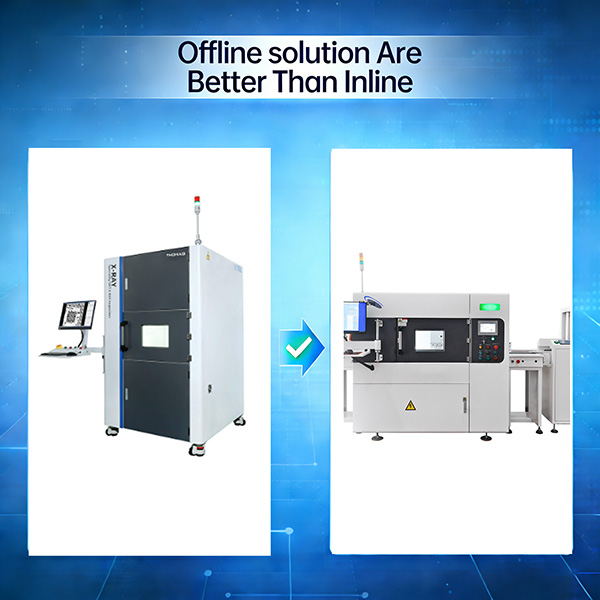
When Offline Solutions Are Better Than Inline – Practical SMT Production Scenarios Explained
Introduction
In SMT manufacturing, inline automation is often seen as the ultimate goal. However, experienced engineers know that inline is not always the best answer.
In SMT manufacturing, inline automation is often seen as the ultimate goal. However, experienced engineers know that inline is not always the best answer.
In many real production environments, offline SMT solutions provide better flexibility, lower risk, and higher overall efficiency.
This article explains when and why offline solutions outperform inline systems in practical SMT scenarios.
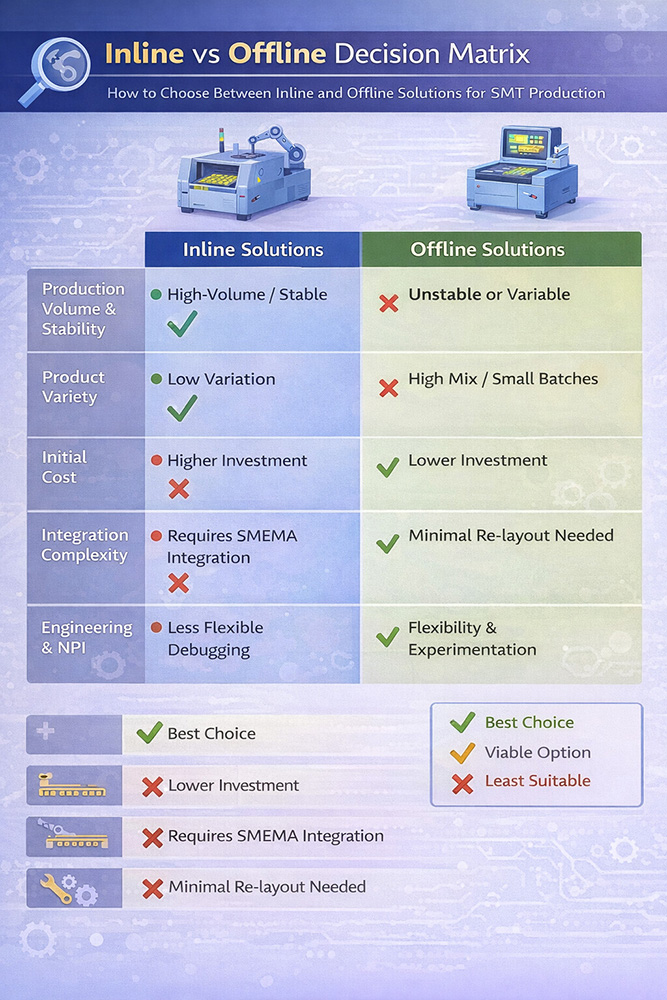
Inline vs Offline – A Quick Definition
Inline Solutions
Integrated directly into the SMT line
Automatic PCB transfer via conveyors and SMEMA
Optimized for high-volume, stable production
Offline Solutions
Operate independently from the main SMT line
Manual or semi-automatic board handling
Designed for flexibility and exception handling
Scenario 1: High-Mix, Low-Volume Production
Inline systems struggle when:
Frequent product changeovers
Different PCB sizes and processes
Short production runs
Offline solutions allow:
Faster setup changes
Independent process tuning
Reduced line downtime
👉 Best Choice: Offline inspection, offline rework, offline cleaning
Scenario 2: Unstable or Bottlenecked SMT Lines
If your line suffers from:
AOI or SPI blocking
Reflow-to-inspection congestion
Frequent SMEMA issues
Inline integration may magnify the problem.
Offline solutions can:
Decouple inspection from production
Absorb takt time fluctuations
Restore line stability
Scenario 3: Cost-Sensitive Expansion Projects
Inline automation often requires:
Conveyors and buffers
Line re-layout
Electrical and SMEMA integration
Offline equipment:
Requires minimal line modification
Has lower initial investment
Can be added incrementally
👉 Ideal for phased factory upgrades.
Scenario 4: Engineering Validation and NPI
During NPI or process validation:
Parameters change frequently
Inspection criteria are not finalized
Debugging is constant
Offline solutions allow engineers to:
Experiment without stopping the line
Analyze defects in detail
Avoid production disruption
Scenario 5: Rework, Repair, and Exception Handling
Inline systems are not designed for:
Manual judgment
Complex rework decisions
Engineering analysis
Offline stations excel at:
BGA inspection
X-ray analysis
Manual verification
Key Advantages of Offline SMT Solutions
Higher process flexibility
Reduced impact on main line throughput
Easier troubleshooting
Lower integration complexity
Better support for engineering tasks
When Inline Still Makes Sense
Inline solutions remain ideal for:
High-volume, stable products
Mature processes
Minimal product variation
Fully automated factories
The key is choosing the right tool for the right stage.
Hybrid Strategy – The Best of Both Worlds
Many advanced factories use:
Inline for core production
Offline for exception handling
Offline as a buffer and safety net
This hybrid approach delivers maximum efficiency with minimal risk.
Conclusion
Inline automation is powerful—but not universal.
Offline SMT solutions often provide greater control, stability, and ROI, especially in real-world production environments where variability is unavoidable.
Understanding when to go offline is a sign of SMT maturity.