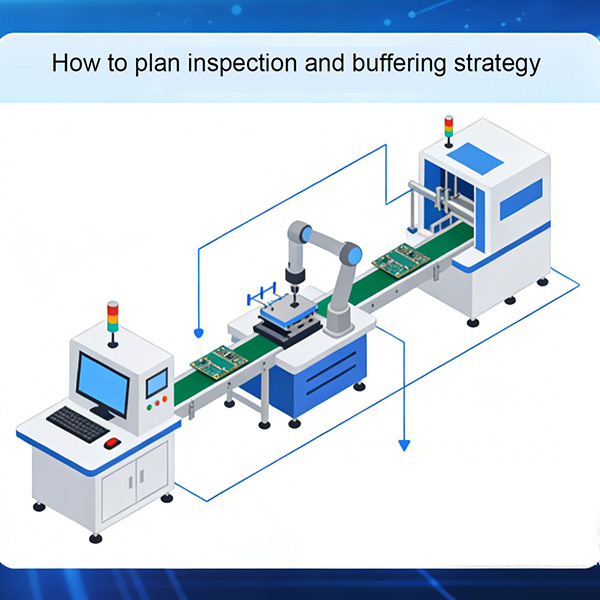
Inspection is essential for quality, but poorly planned inspection flow often becomes the largest hidden bottleneck in SMT production lines. A well-designed inspection and buffering strategy ensures stable throughput without sacrificing quality.
This guide explains how to plan inspection placement, buffering capacity, and recovery flow from an engineering perspective.
Why Inspection and Buffering Must Be Planned Together
Inspection machines such as SPI and AOI typically have:
Variable cycle times
High sensitivity to parameter changes
Manual intervention during NG handling
Buffers act as shock absorbers that:
Decouple process timing
Prevent upstream blocking
Allow inspection recovery without stopping the line
Inspection without buffering often leads to instability.
Key Inspection Points in an SMT Line
Typical inspection stations include:
Post-print SPI
Pre-reflow AOI
Post-reflow AOI
X-ray inspection (selective or offline)
Each inspection point affects line balance differently.
Step 1: Define Inspection Objectives
Before planning buffers, clarify:
Defect detection priority
Acceptable false call rate
Inspection coverage level
Not all products require maximum inspection at every stage.
Step 2: Match Inspection Cycle Time to Line Takt Time
Compare:
Placement machine output
Reflow throughput
Inspection cycle time
If inspection cycle time exceeds line takt, buffering or parallel inspection becomes mandatory.
Step 3: Decide Inline vs Offline Inspection
Use inline inspection when:
Production is high-volume and stable
Inspection programs are mature
Choose offline inspection when:
Product mix is high
Inspection results require engineering review
Line stability is at risk
A hybrid approach often delivers the best results.
Step 4: Design Buffer Capacity Strategically
Buffer placement recommendations:
Before AOI to absorb inspection fluctuation
After AOI to allow recovery without blocking upstream
Between major process stages
Avoid excessive buffering, which can hide real process issues.
Step 5: Plan Inspection Recovery Flow
A good recovery plan includes:
Clear NG routing logic
Defined operator actions
Visual indicators for board status
Fast restart procedures
Recovery time is as important as inspection speed.
Common Buffering Mistakes to Avoid
Over-buffering without root cause analysis
Placing buffers only after problems appear
Ignoring inspection false call impact
Using buffers as permanent fixes
Buffers should support flow, not mask inefficiency.
Advanced Strategies for High-Mix Lines
For complex environments, consider:
Smart buffering with priority logic
Dynamic inspection parameter switching
Offline review stations
Data-driven inspection adjustment
These approaches increase flexibility and resilience.
When to Redesign Inspection and Buffering Strategy
Inspection and buffering strategy directly impacts SMT line stability and productivity. The goal is not to eliminate buffering—but to use it intelligently.
A balanced strategy delivers consistent throughput, controlled quality, and lower operational stress.